In December 2005 I blogged about the new set of programming languages (Metaphor and Fortress - New programming Languages) and how multi core systems could change the computing scenarios. Here is something more on multi core systems. Last week Azul systems announced a 48 way multi core chip, redefining the enterprise computing. However, the current hurdles for the Intel, Sun, IBM and other Hardware vendors with multi core CPUs will be picking the right memory technologies. "If you can't keep the cores fed fast enough from memory, you haven't gained anything," says AMD chief technology officer Phil Hester.
 The Vega 1 chip (from Azul) can support a maximum of 384 cores while the new chip supports a whopping 768 cores which takes up 11U of rack space. Like Vega 1, Vega 2 is a 64-bit and all its cores are cache-coherent (fully independent). Intel uses Smart Cache technology to share the level-2 (L2) cache among the cores instead of dedicating a L2 Cache per core. The immediate benefit of this is that both the core has the entire 2MB of L2 cache. The data (in the L2 Cache) can be changed by one Execution Core and subsequently be utilized by the other Execution Core without the need to first write the data to DRAM. As the data is shared with L2 Cache, the traffic on the FSB (Front Side Bus) is minimized.
 The Vega 1 chip (from Azul) can support a maximum of 384 cores while the new chip supports a whopping 768 cores which takes up 11U of rack space. Like Vega 1, Vega 2 is a 64-bit and all its cores are cache-coherent (fully independent). Intel uses Smart Cache technology to share the level-2 (L2) cache among the cores instead of dedicating a L2 Cache per core. The immediate benefit of this is that both the core has the entire 2MB of L2 cache. The data (in the L2 Cache) can be changed by one Execution Core and subsequently be utilized by the other Execution Core without the need to first write the data to DRAM. As the data is shared with L2 Cache, the traffic on the FSB (Front Side Bus) is minimized.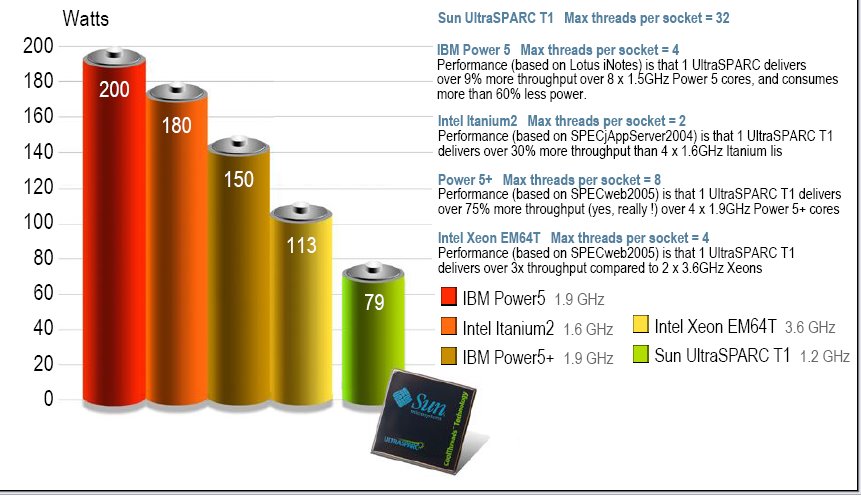
Today we have single CPU with 8 cores and 32 parallel threads from Sun Microsystems and 48 Core Chip from Azul Systems - imagine the state of these technologies after a decade. GRID computing for the common man (a digitally connected world) will be a reality.
Imagine the year 2015. Parallel computing with Autonomous Executable Entities will be a reality!
Further
- Azul Systems – Vega 24 Core chip Azul Compute Appliance
- Techworld – Azul launches 48 core processor
- Sun Microsystems – Sun UltraSPARC T1 Processor
- Sun Microsystems – Multi Core Processor Comparisons
- Intel – Dual Core Processor Demo
- Intel – Smart Cache: Sharing L2 cache among the cores
- Intel – Next leap in multiprocessor Architecture: Intel Dual Core
- Intel – Intel Core Duo Processors
- Intel – Dual Core Intel Xeon Processors
- Silicon Graphics - ccNUMA
- Wikipedia – Non Uniform Memory Access (NUMA)
- MIT Technology Review - Faster Plastic Circuits
- MIT Technology Review – Multicore Mania
- MIT Technology Review – Making Multicore Fly
- MIT Technology Review – Good bye, Gigahertz
- InfoWorld - Sun charges Sun Fire T2000 with UltraSparc
- Wikipedia.Com – Cache Coherency
- MIT – Cache Coherence
- Webopedia.Com – What is Cache Coherence?




 Posts
Posts

